
When Indiana Arrest Records Are Public
Indiana's Access to Public Records Act gives the starting point. People may inspect and copy records kept by state and local agencies. The law spells this out in Ind. Code § 5-14-3-2(o). That provision counts photographs as public records. Section § 5-14-3-3 sets the baseline right of access. So a booking photo, an intake record, or an arrest report can all fall under APRA. An exception in § 5-14-3-4, a court rule, or a court order can still block it. Section 5-14-3-9 lays out denial and enforcement steps. Even a public record, though, is only as reachable as its custodian allows.
Posting online is a separate matter. A county roster might show who is in custody. It may skip photos or trim its date range. When a record is missing from that view, an APRA request can seek it out. If a custodian denies access, that office should name the law supporting the denial. The word "mugshot" alone does not make an image confidential. The Public Access Counselor has said as much.
| Record source | What it can answer |
|---|---|
| Arresting agency | Incident report, arrest details, or the agency’s daily log. |
| County jail | Intake, booking number, custody status, release, and possibly a photo. |
| Court clerk or MyCase | Public filings, hearings, and later case disposition, not live custody. |
| State correction system | State-prison custody after sentencing, not a county booking feed. |
Indiana Arrest-Record Request Timelines
APRA sets a deadline for the response, not for full delivery. The Public Access Counselor handbook draws clear lines. An oral or hand-delivered request must get a response within 24 business hours. A mailed, emailed, or faxed request gets seven calendar days. Producing the actual records can take longer, since staff must locate, review, redact, or copy them.
Responses vary. An office may confirm receipt, give a time estimate, or state that no matching record exists. It can also deny access with its legal basis. Fees follow the custodian's lawful schedule and depend on the copy type and labor involved. Name the record clearly. Give staff enough detail to find it. When records are withheld, ask which APRA exception applies and whether a redacted copy could be released instead.
A focused request can follow these steps:
- Identify the agency that made the arrest or took the person into custody.
- Describe the arrest or booking record, photograph, incident report, or daily log sought.
- Give the person’s name and the known arrest date, booking date, or agency details.
- Ask for an estimate of any lawful copy charge and the expected production date.
- If access is denied, request the specific statutory basis and the name of the responsible custodian.
Ask by name for each separate item. That means the arrest report, booking or intake record, daily log entry, and photograph. A denial or a long delay can go to the Indiana Public Access Counselor, and APRA also offers a court-enforcement route.
Note: APRA response timing is not the same as final production timing for requested records.
What Indiana Booking Records Include
Indiana's jail-administration rule lists what intake captures. The booking number, intake date and time, name and aliases, charges, reason for detention, mug shot, fingerprints, physical description, demographic details, and court or sentence information all appear in the rule. Keep one thing clear. That rule covers records kept at intake, not what each county roster must display online. A web page may hide fields, skip the booking photo, or drop a person once custody ends.
State law adds another layer. Under Ind. Code § 5-14-3-5, law-enforcement agencies must keep a daily log covering suspected crimes, accidents, and complaints. The log records when the information arrived, the location, a factual summary, the incident number, and the responding agency. Jail information is handled apart from this log. Neither rule promises a live statewide roster, a same-day booking page, or an online mugshot gallery. When the public view lacks a record, ask for the specific document by name.
Different offices hold different pieces. The arresting agency keeps incident reports. The jail holds intake and custody records. The court clerk keeps the filings and case outcomes. 210 IAC 3-1-6 lists intake data but guarantees no web display. The statewide jail search covers only participating counties, and MyCase is a court search rather than a jail locator or a full criminal history.
Indiana Mugshots and Online Rosters
A public-record right and a web roster are two different things in Indiana. APRA and the PAC treat booking photos as records you can request. Still, a sheriff has no duty to post every mugshot online. A roster may list a name and status. The booking photo itself may sit in a file at the jail. To see it, you ask.
Agencies get some discretion. APRA permits withholding investigatory records. The PAC adds that a custodian must apply one consistent policy and give supporting facts. Labeling a record investigatory does not make it so. A few situations can genuinely change the outcome. An active investigation, a juvenile matter, or a protected victim detail can matter. A judge can order a warrant kept secret.
The Public Access Counselor's mugshot and warrant guidance spells this out. A request can succeed even when no photo appears on a roster. The same guidance warns that an unserved warrant can be confidential. A judge may have ordered it withheld. If part of your request is denied, ask the custodian. Ask which statute or court rule supports it.
Indiana's 210 IAC 3-1-6 intake rule is often misread. It sets the fields a jail must record, not what belongs on a public website. A roster with no image does not mean no booking photo exists.
Note: Public-record access does not require every county roster to publish every field or booking photograph online.
Why Indiana HB 1170 Failed
Indiana once debated House Bill 1170. The 2022 "Arrestee Publicity" proposal would have limited disclosure in defined cases, with exceptions for fugitives and imminent threats. It died in the legislature. The Indiana General Assembly bill history preserves the record. No Indiana law targets mugshot pay-to-remove fees today, and no publisher faces a penalty for charging one.
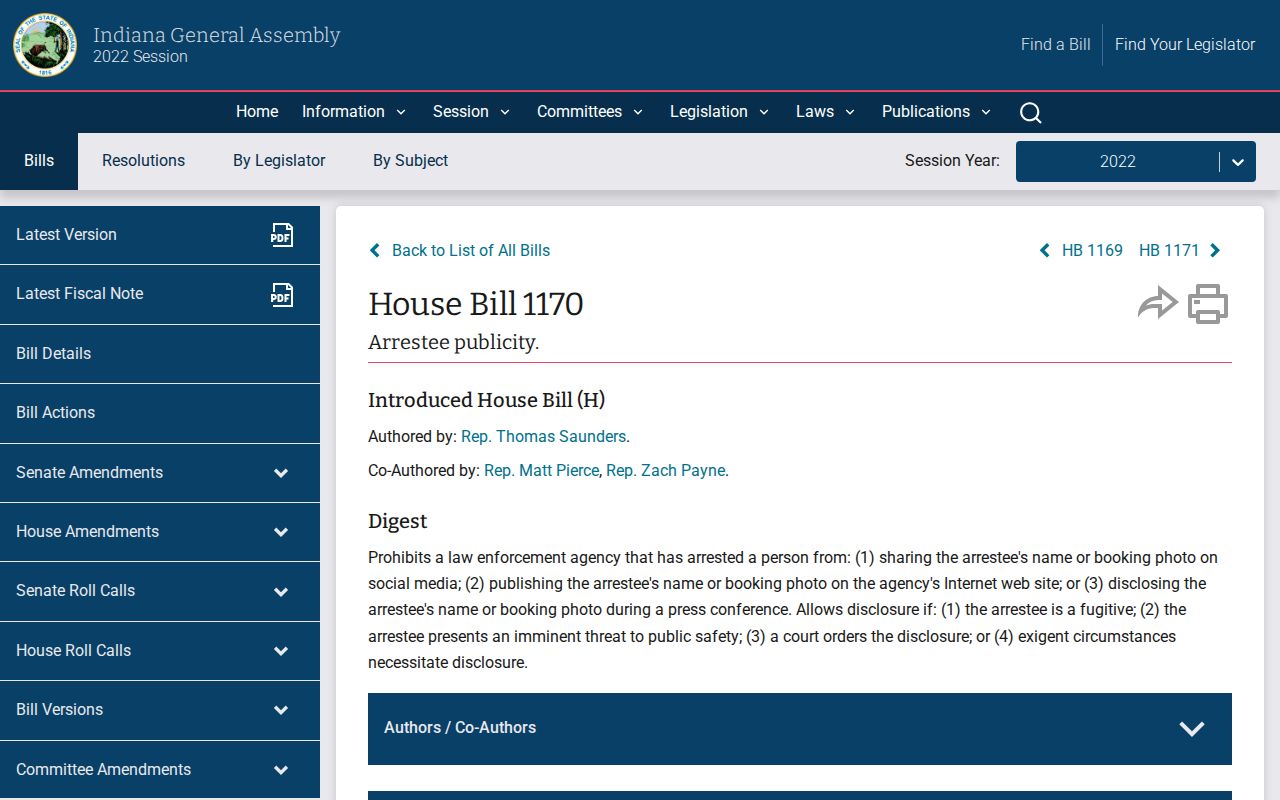
The bill's final status is clear enough. No Indiana court decision on a general mugshot-removal law has been reported. That silence proves little, and other claims plus court orders stand on their own.
Indiana Juvenile Arrest Records Stay Protected
Juvenile arrest records live under different rules in Indiana. The Public Access Counselor's juvenile-record guidance is the place to start. Ind. Code § 31-39-3-4 makes law-enforcement records on juvenile delinquency confidential unless an exception applies. Juvenile-court records stay closed too, under § 31-39-1-2 and the court's access rules. An adult booking feed grants no license to name a youth. Nor may you repeat a name, charge, or mugshot pulled from an old third-party copy. A birthday changes nothing by itself. Turning 18 does not erase a juvenile record. Sealing blocks public access; destruction means the record is gone for good. Base any request on the actual order and the record's current legal status, not on a stale public page. The Indiana courts' juvenile forms page gathers the official petition and order materials. Having forms does not mean every case qualifies for relief, juvenile or adult.
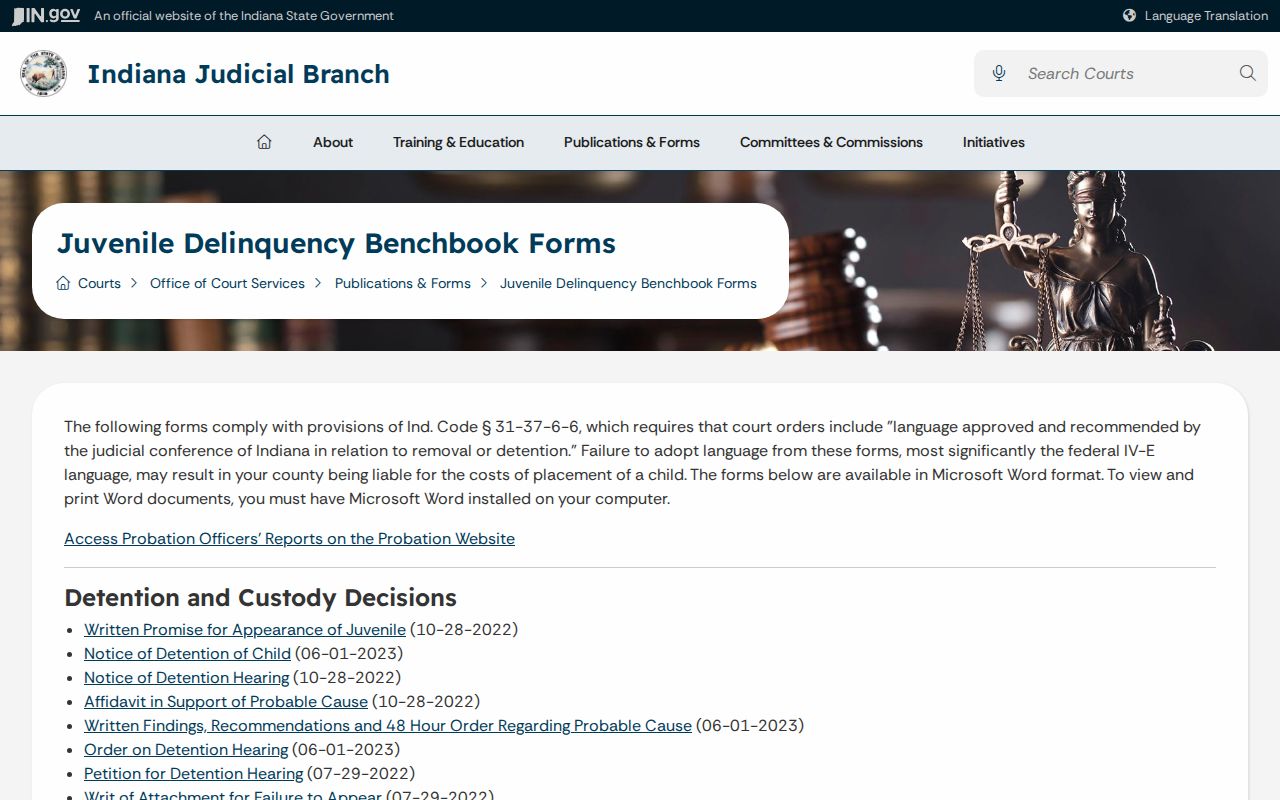
The form links lead to official resources. Protected details can span victim identities, medical records, informants, private addresses, and anything a statute or court order bars, and APRA leaves those protections standing.
How Indiana Expungement Changes Access
Expungement is court-ordered relief. Once a judge signs the order, public access to the covered record changes. Indiana Code § 35-38-9 governs the process. It reaches arrest records, dismissed charges, juvenile matters, and certain files reopened after a conviction is vacated. For most cases, the wait runs one year. That clock starts from the arrest, the charge, or the vacatur. A prosecutor can consent to a shorter wait. Some dismissals clear automatically once the statutory terms are satisfied. Eligibility still turns on how the case ended and whether the law's conditions are met.
Conviction cases follow their own timeline. Misdemeanors, along with Class D or Level 6 felonies later converted to misdemeanors, generally wait five years after conviction. Qualifying Class D or Level 6 felonies without bodily injury generally wait eight. For other qualifying felonies with no serious bodily injury or death, the period is the later of eight years after conviction or three years after sentence completion. The remaining eligible felonies, short of those involving death, use the later of ten years after conviction or five years after sentence completion. Prosecutor consent can trim some of these windows. Exclusions, restitution, pending matters, later convictions, and offense details all shape the final answer.
| Record situation | General framework |
|---|---|
| Arrest or charge without conviction | Generally one year, with some prosecutor-consented shorter timing and qualifying automatic dismissals. |
| Misdemeanor or qualifying reduced felony | Generally five years after conviction, subject to eligibility terms. |
| Qualifying lower-level felony without bodily injury | Generally eight years after conviction. |
| Other qualifying felony without serious injury or death | Later of eight years after conviction or three years after sentence completion. |
| Remaining eligible felony without death | Later of ten years after conviction or five years after sentence completion. |
Categories 4 and 5 get special treatment. A felony record may stay publicly marked as expunged instead of fully hidden. No broad claim that all arrests vanish after one year holds up. The Indiana courts' expungement statutes lay out the current framework. But a court order and the outcome control.
Once granted, the order binds the court, police, prosecutor, and jail. It also binds other custodians the law covers. It cannot erase a private copy. A screenshot or search-engine cache survives it too. Work the order with each original custodian first, then ask a publisher to correct or remove material that remains. Those are two separate steps, and neither replaces the other.
Note: Expungement changes official access under the order; it does not automatically remove a publisher’s stored copy.
Free Indiana Publisher Correction Routes
Several publishers run no-fee correction routes under their own policies. Such requests never change official records. They also cannot promise removal of every private copy.
Busted Newspaper's correction form asks for a listing URL, contact details, a reason, and proof. Review runs about 5 to 10 days. The route costs nothing. A court order or an agency record change is another matter entirely.
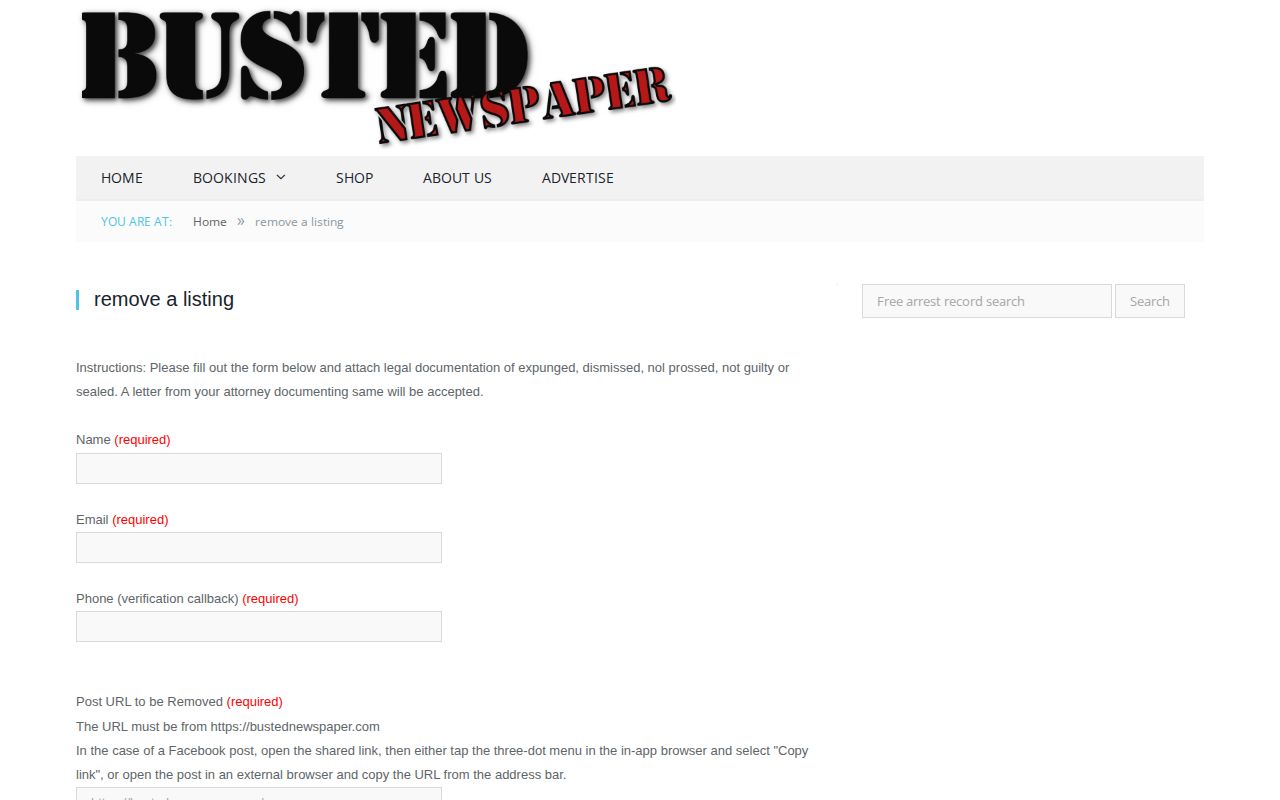
Busted Newspaper's own document review route appears in the image, not an official record change.
Indiana RecentlyBooked Arrest Corrections
RecentlyBooked’s removal policy spells out its options plainly. Qualifying requests cost nothing. Grounds include dismissal, expungement, sealing, mistaken identity, outdated details, juvenile status, or a duplicate listing. Accurate current public-record information, though, stays up even when someone simply wants it gone.
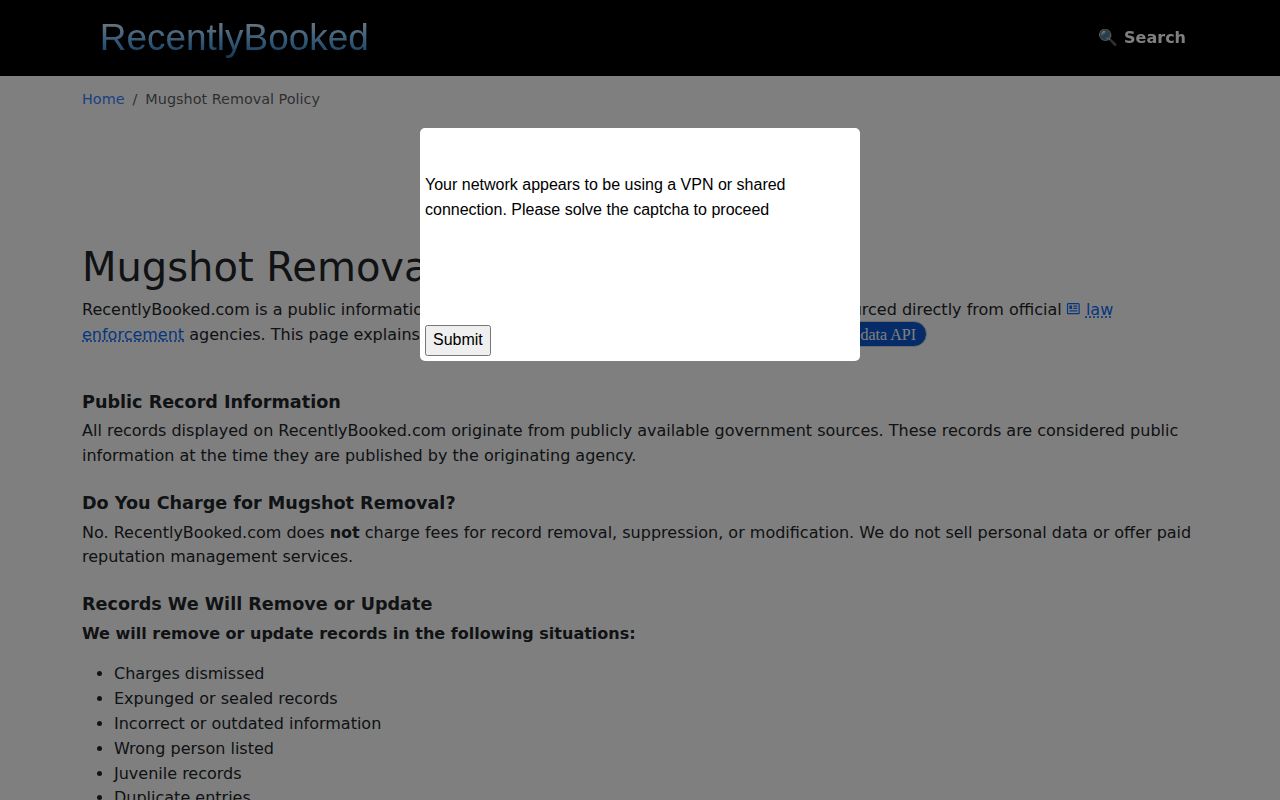
The image shows RecentlyBooked’s own stated correction terms.
Indiana Mugshots.com Record Maintenance
Mugshots.com’s record-maintenance policy takes a similar stance. Updating or removing a record costs no fee. The site reviews documentation you supply, and that review can run up to 10 business days.
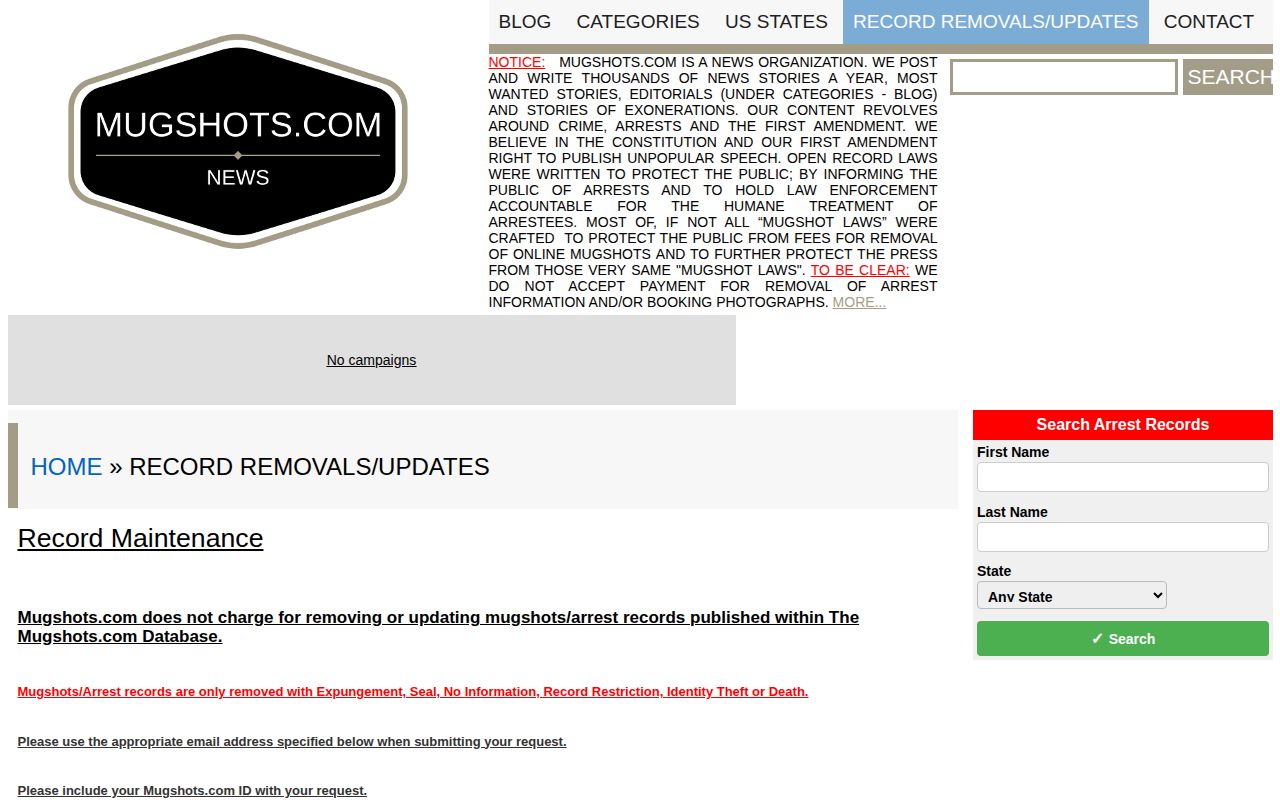
The screenshot reflects Mugshots.com’s stated update route.
Note: A publisher policy is a voluntary process and does not change Indiana’s government records.
Indiana Mugshots.zone and Arrests.org Requests
Mugshots.zone’s Washington County request page accepts no-charge requests with supporting documents attached. Expect roughly a 10-day review. Policies vary by subdomain and shift over time, so read the exact publisher page first. Arrests.org posts no clear written free removal rules on its Indiana pages. Its contact route is the way in, ideally with court or correction papers. A takedown is never promised.
Never pay anyone claiming a fee is required. No official record or court remedy demands payment. A publisher’s no-fee policy is one thing; a court petition is another. Keep copies of the URL, your request, and the supporting court paper.
Indiana Court and Search Cache Updates
Sometimes a source page truly changes or vanishes, yet the old version lingers in results. Google’s Refresh Outdated Content tool asks the search index to catch up. It cannot do more than that. No expungement order comes from it. No live page gets deleted, and copies elsewhere stay put. When the worry is the official Indiana court record, that is a different problem. The MyCase access guidance covers what stays public after expungement. State access rules and publisher copies are separate matters.
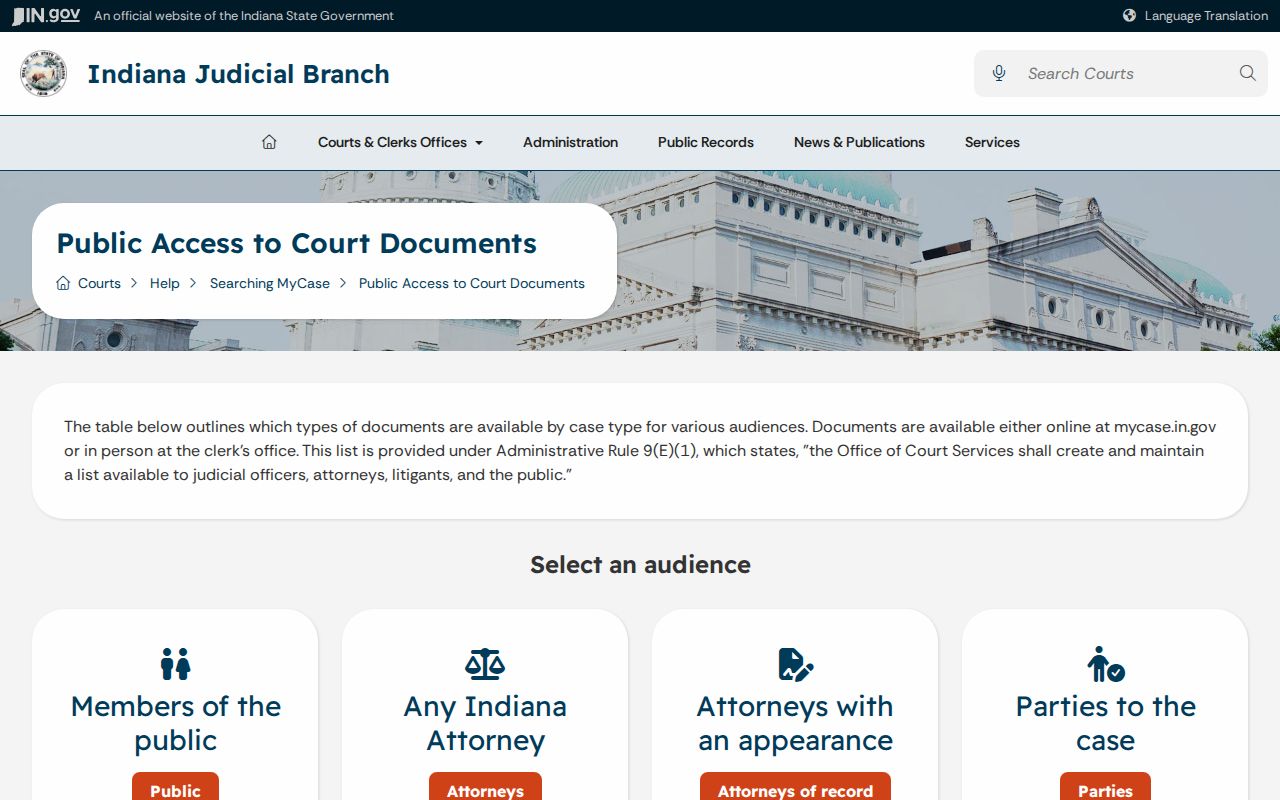
That court guidance only affects MyCase visibility. A publisher’s separate copy remains untouched. For a wider view of where Indiana booking photos and arrest records surface, the statewide arrest and photo overview maps the landscape. The Indiana State Police arrest-publication page handles its enforcement releases, while county jails stay the right custodian for county intake records.