
Indiana Arrest Logs Over Several Days
Indiana keeps no single daily booking blotter covering every county. Daily Arrest Report routing helps you start with a fresh booking. INjail covers only participating counties, and only within a 30-day window. It is not a statewide arrest archive. Each sheriff or jail vendor decides what to display. Some show current inmates. Others show released inmates or short-range rosters. Police logs record a different stage entirely. Indiana State Police publishes selected releases rather than every arrest. Match each result to its custodian and record type, since a booking, a police log, and a news story each capture a different moment. A county log, a court update, or an APRA request may each be needed for a full picture.
Where Indiana Arrest Logs Live
Start with the official custodian of the record.
| Source | What it may show | Scope and limit |
|---|---|---|
| INjail | Participating-county custody and date searches | 30-day online view; not all counties or all arrests |
| County sheriff or jail | Current, released, or short-window roster fields | Window, image display, and update pace vary |
| Arresting police agency | Daily log, incident report, or arrest report | May differ from the jail's intake record |
| ISP newsroom | Selected event and enforcement releases | Event-driven, not a statewide booking table |
| Indiana courts MyCase | Public case entries and later court activity | Not a custody roster or proof of a current hold |
| Newsrooms and secondary publishers | Selected incidents, context, or copied booking details | Incomplete and not a substitute for the source record |
The official INjail search covers participating counties. Its date fields reach beyond a same-day check. Other counties may list current custody, released names, or a static document. Follow the sheriff's own link to confirm a source. Vendor branding never makes a roster complete. Use Indiana MyCase for later case activity; it does not show current custody, a case can postdate booking, and some records stay closed.
Indiana Arrest Records Have Separate Timelines
A current-custody view can end at release. A released list may keep an entry longer. The arresting agency holds its own report. A news story may beat a MyCase entry, and a later hearing or disposition adds context. Disposition simply means the court's result, such as a dismissal or judgment, and each layer carries its own date.
| Record layer | Usual question it answers | Why its date differs |
|---|---|---|
| Current jail roster | Does this feed show the person in custody now? | It can drop the entry at release or after a refresh |
| Released or archived roster | Was a person listed in an earlier custody period? | Each county or vendor sets its public display range |
| Police log or report | What event did the agency record? | Entry, review, and public release follow agency practice |
| News report | What incident did the newsroom select to cover? | Editorial publication can follow the event or release |
| Court docket | What case activity or disposition is public? | Filing and court updates come after or apart from booking |
A missing court result does not disprove an arrest. An old jail entry is not a final outcome. Match the name, county, date, and case number, and ask the custodian when unsure.
Indiana News Arrest Blotters
News outlets pick which incidents to cover. None forms a complete statewide blotter. The ISP newsroom posts official releases and enforcement campaigns. Coverage there is event-driven. Local reporting may add interviews, public-safety context, or a later court update. For an agency's own record, ask the police, jail, or court directly. Indiana coverage includes WISH-TV, WRTV, WTHR, FOX59/CBS4, WFYI, and the Indiana Capital Chronicle, each with a public contact route. Send the story link plus proof of an error or later result; contact is free, and a correction request never promises removal of an accurate story.
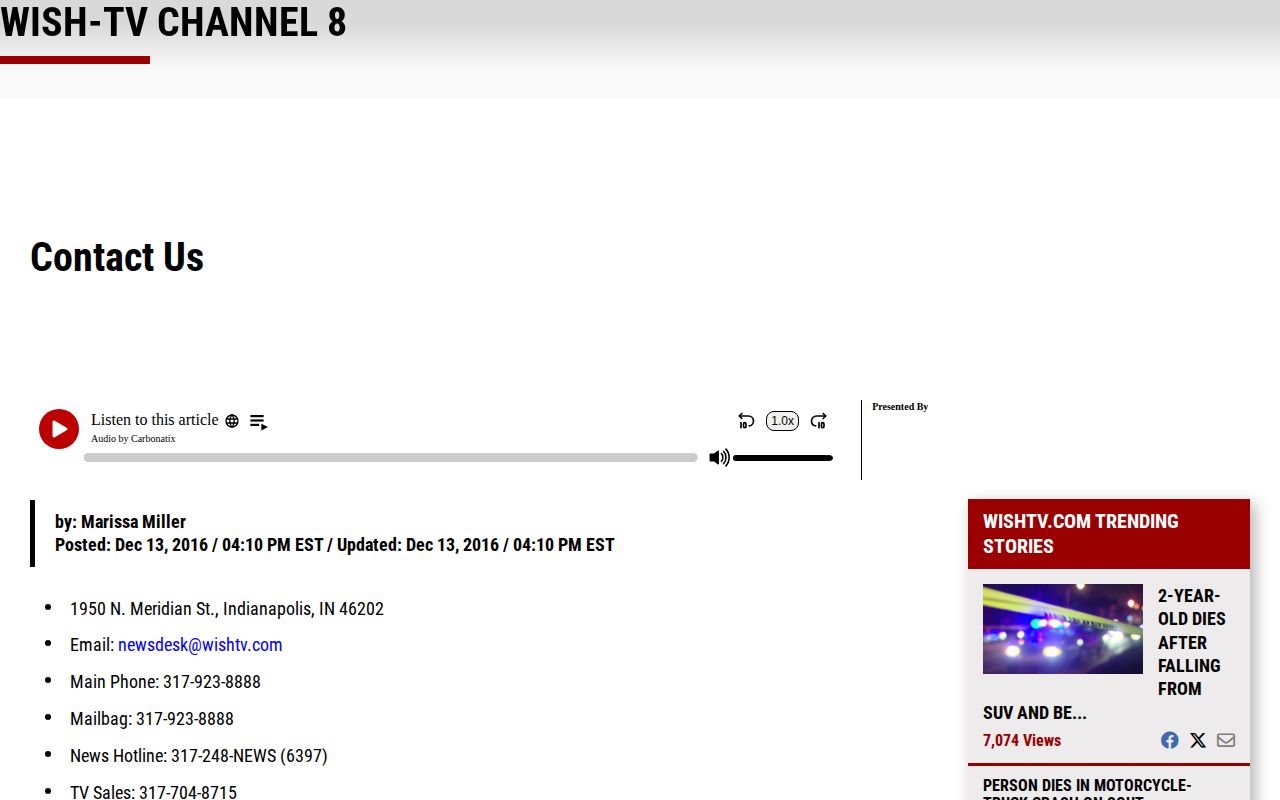
The WISH-TV contact page lists a free newsroom contact route.
WRTV, WTHR, FOX59/CBS4, WFYI, and the Indiana Capital Chronicle all take reader contact through public channels. Corrections are possible. Verified context can be added. None promises to delete a truthful story. Check whether the report names an arresting agency or jail, then compare its claims with that custodian's record, since a headline is not a court disposition.
Indiana Aggregator Arrest Logs
Private publishers copy county booking data and photos. They stay secondary sources. County coverage is often partial, and updates may lag the jail. A copied entry can lack later court context. Check the official roster first. RecentlyBooked Indiana arranges county sections and says its material generally spans the prior 30 days. Its list leaves out some counties, so verify the name and event with the sheriff, jail, or arresting agency.
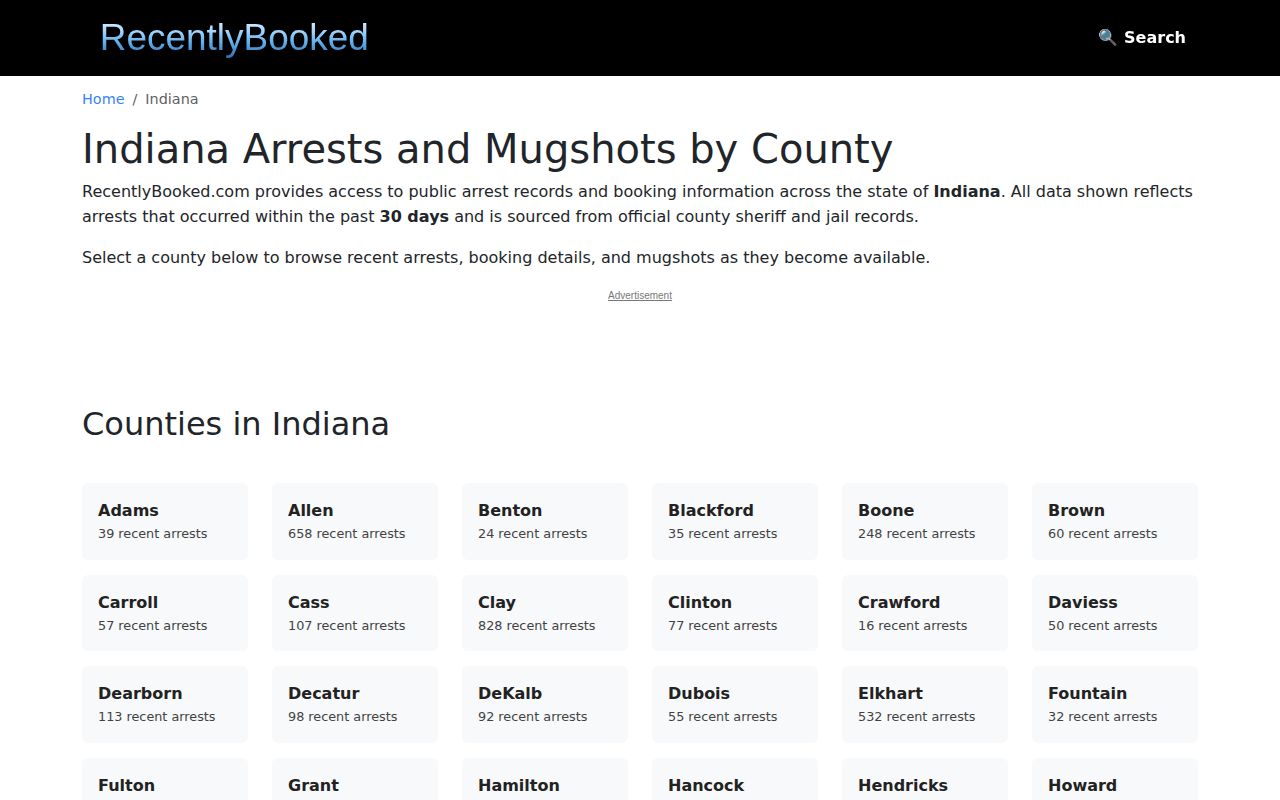
The RecentlyBooked Indiana landing page is a private, incomplete index.
Mugshots.com Indiana is a private state and county archive. Its counts may not match a current roster. The state page is not an official live record. An old listing may omit the later outcome. Mugshots.zone routes to county pages rather than one all-state roster.
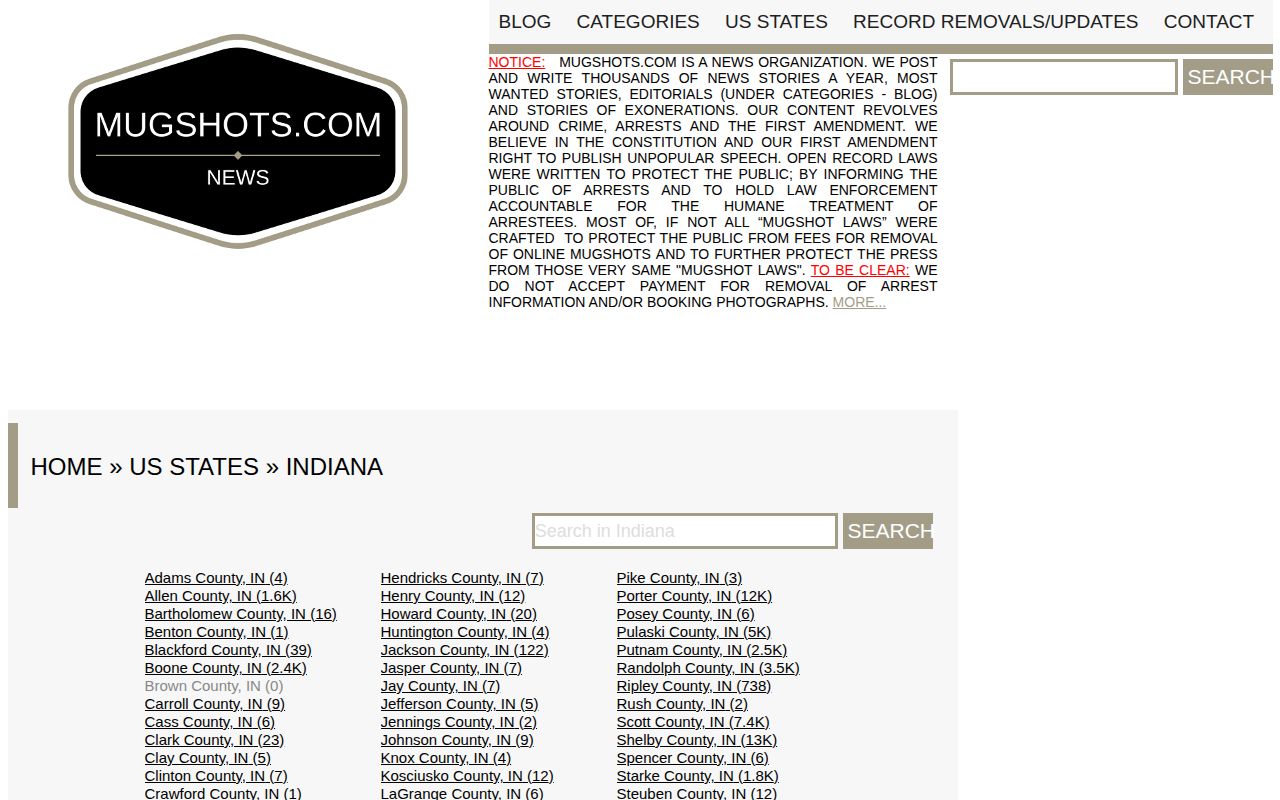
The Mugshots.com Indiana page shows a state landing view, not a government feed.
The Mugshots.zone Indiana links page routes to county subdomains. It is not one statewide arrest index. Busted Newspaper Indiana and Arrests.org Indiana also publish booking material. No private publisher is the final word on custody, identity, or case outcome. Their state pages never replace the jail record.
The Mugshots.zone landing page links county-level destinations, not one index.
Note: A publisher's correction route works separately from a court order or any change to the official government record.
How to Find an Indiana Arrest Log
Follow each record back to its custodian, and keep the county, date range, and source noted with the result. The County Directory in the top navigation routes to sheriff and jail sites.
- Set the likely county and the dates to cover. Include a few days around a weekend or holiday if the exact booking date is unknown.
- Search INjail for a participating county and compare the booked and released date fields. The portal's online window is not the same as a county's archive.
- Open the county sheriff or jail page for current and released-custody views. If the interface has no older range, ask the records unit what period it retains online.
- Check the arresting agency's daily log or report for the event itself. Use ISP's newsroom only for its selected state police releases.
- Search MyCase for later public court activity, then confirm any important record with the court or agency that made it.
Resist merging matching names into one story. One source may cover the booking while another tracks a warrant or a court case. The statewide recent-arrest overview helps separate those record types.
Weekend and Holiday Log Gaps
Indiana sheriffs share no weekend posting schedule. A Monday jail roster can carry several days of bookings at once. A feed may still miss a Saturday arrest entirely. Counts also shift as staff clear backlogs, process releases, or refresh vendor systems, and no statewide weekend cadence exists.
News stories sometimes bundle weekend events together. The jail logs each arrest on its own clock. A roster can even shrink after a release, despite more arrests happening. For live custody status, use the daily search. Call the jail when timing matters. Want a longer view? Request dated daily logs. A partial page never proves a trend.
A gap is not a count. When weekend or holiday entries are missing from an arrest log, that silence proves nothing, and a later batch of bookings is just catch-up posting rather than evidence of a real surge in arrests.
Indiana Arrest Record Archives
A county jail roster shows one thing online. What the agency legally keeps is another. A roster may display only a narrow window. The underlying custody file can survive far longer. Boone County's JailTracker setup carried a released-entry setting of 5,475 days. That figure reflects vendor behavior, nothing more. It is not a state retention rule. Nor is it a promise that any booking photo stays online.
The Indiana Archives and Records Administration county and local retention schedules are the official starting point for older local public-safety records. A schedule tells you how long an agency must keep a given record series. Under the public-safety schedule, an adult custody file is destroyed ten years after incarceration ends. A juvenile file waits for the later of two dates. One is ten years after custody ends. The other is seven years after the person turns 18. Arrestee fingerprint records are permanent. These rules bind government record series only. They say nothing about web roster or photo display time.
Chasing an older Indiana arrest record works best on paper. Name the agency, the person, the date range, and the item sought. Put the request in writing. Ask plainly for the booking file, daily log, report, or photo. An APRA response may arrive before production, and lawful copy charges can apply. If the agency holds no record, ask whether another one does. Historic IDOC holdings at IARA travel a separate route.